The short answer
Yes, a good RFID-blocking wallet works — it really does stop contactless cards from being read while the wallet is closed. The honest part: RFID skimming is much rarer in real life than the scary videos suggest, because readers need to get within a few centimeters and modern contactless cards send a one-time code for each payment. So think of RFID blocking as a cheap, always-on extra layer, not the main event. The bigger everyday risk is losing the wallet itself — which is why the smartest wallets pair RFID protection with a slim shape and a built-in AirTag slot.
Few wallet features get marketed as hard as RFID blocking. Product pages show a stranger with a scanner brushing past your back pocket and walking off with your credit card. Then you read a skeptical article that calls the whole thing a gimmick. Both can't be right — and as usual, the truth is somewhere sensible in the middle.
Below we break down what RFID actually is, what the shielding does, how big the skimming risk really is in 2026, how to test your own wallet in one minute, and when an RFID wallet is genuinely worth buying.
What RFID (and contactless) actually is
RFID stands for radio-frequency identification. The tap-to-pay chip in your credit or debit card, many hotel key cards, office badges and transit cards all use short-range radio to talk to a reader. Contactless payment cards use a standard called NFC (near-field communication), which works at very short distances — typically a few centimeters, about an inch or two.
The card has no battery. The reader's radio field powers the chip just long enough to exchange data. That detail matters, because it's exactly what an RFID-blocking wallet interrupts.
How an RFID-blocking wallet works
An RFID-blocking wallet surrounds your cards with a conductive layer — aluminum, a metal mesh lining or carbon fiber. That layer acts like a small shield (the same principle as a Faraday cage): the reader's field can't get through to the chip, so the chip never powers up and has nothing to say.
Weighing materials for your next wallet? See our comparison of carbon fiber vs leather wallets, or decode the jargon with our wallet glossary of 12 smart-wallet terms.
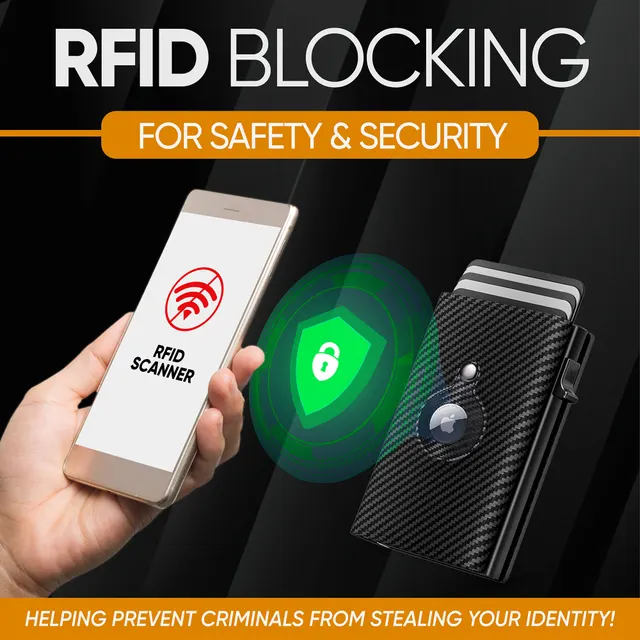
Two practical points follow from that:
- It only protects what's inside. Cards in a closed shell are shielded; a card sticking out of an open slot, or tucked into your phone case, isn't.
- It never gets in the way of normal use. Slide the card out and it taps, dips and swipes like always. The one small trade-off: you can't tap the whole wallet on a transit gate — you take the card out first.
Is RFID skimming a real threat? The honest version
Here's where we try to be straight with you. Researchers have shown for years that a contactless card can be read without the owner noticing, so the risk isn't invented. But in everyday life it's uncommon, for three reasons:
- Range is tinyA reader has to get within a few centimeters of the card, through clothing and leather. That's a lot harder to do discreetly than it looks in a demo.
- The data is limitedModern contactless bank cards generate a one-time code for each transaction instead of handing over reusable card details, which makes skimmed data far less useful to a thief.
- Easier fraud existsPhishing, data breaches, card-reader skimmers at gas pumps and ATMs, and plain old pickpocketing are much simpler for criminals — and much more common.
So is an RFID wallet pointless? No. It's the kind of protection that costs you nothing in daily use, never needs switching on and covers a risk that, while small, isn't zero — especially for IDs, work badges and key cards that may not use the same protections as your bank card. It's simply not the whole story. If you are upgrading anyway, our list of 8 smart everyday-carry swaps for men shows how an RFID wallet fits into a lighter, easier-to-find carry.
Test your RFID wallet at home in one minute
You don't have to take the marketing on faith. If you have a phone with NFC (most modern iPhones and Android phones do), you can check any wallet yourself:
- Install a free NFC or card-reader appPlenty of free apps simply detect whether a contactless card responds.
- Scan the bare card firstHold the card against the back of your phone. The app should detect it — this proves the test works.
- Now scan it inside the closed walletPut the card in the wallet, close it and hold the wallet against the phone the same way. A working RFID wallet should show nothing.
Try it from both sides of the wallet. If the card still reads, the shielding has gaps — common with cheap sleeves or wallets where only one panel is lined. (Curious whether homemade fixes hold up? We compared RFID blocking sleeves, foil and a ready-made RFID wallet side by side.)
When an RFID-blocking wallet is worth it
| Situation | How much RFID blocking helps | What matters more |
|---|---|---|
| Daily commute, crowded transit | A nice extra layer | Front-pocket carry and knowing if the wallet leaves with someone else |
| Travel, airports, tourist areas | Useful peace of mind for cards and IDs | Splitting cards, and a tracker for wallet and luggage |
| Several contactless cards, badges, key cards | Good — one shield covers all of them | Fast access so you're not fumbling at the gate |
| Mostly using phone wallet payments | Smaller benefit | Protecting the ID and backup cards you still carry |
Notice the pattern in the right-hand column: in almost every case, the thing that actually costs people time and money is the wallet going missing — left on a café table, slipped out of a back pocket or lifted on a packed train. We covered how that happens in our article on subway theft in 2026.
The smarter upgrade: RFID blocking plus a way to find the wallet
That's why we like wallets that treat RFID as one feature among several rather than the headline. The SafeTrack Wallet is a good example. It's a slim carbon fiber shell with RFID blocking built in, a slide lever that fans your cards out in a second, and — the part that matters most day to day — a built-in slot for an Apple AirTag. With an AirTag in place (sold separately), the wallet shows up in the Find My app on your iPhone with a last-seen map location, a sound you can play when it's under the couch, and left-behind alerts when you walk away from it.
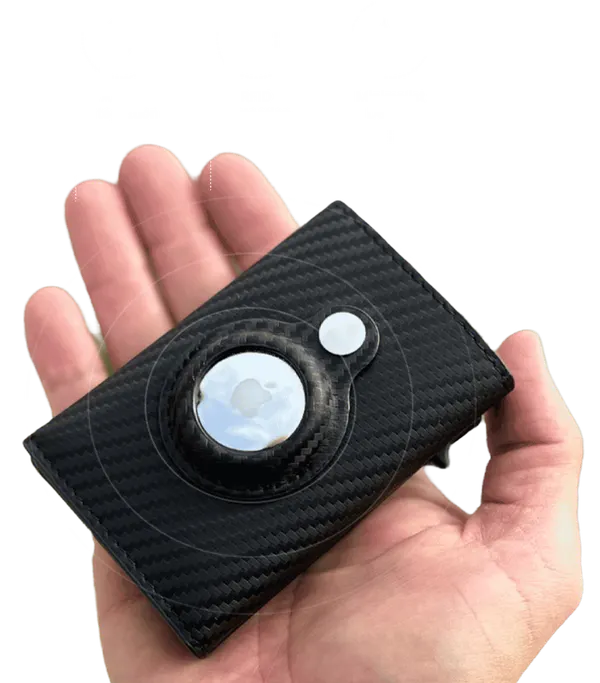
- RFID blocking, always on: shields the contactless cards and IDs inside, with nothing to switch on.
- AirTag-ready: a secure, flat home for the tag — no bulge, no tag sliding out of the bill pocket. If you're weighing other options, see our comparison of 5 ways to put an AirTag in your wallet.
- Slim and light: about 1.7 oz, holding 1 to 14 cards plus up to 20 bills.
- 90-day money-back guarantee: plenty of time to carry it, test the shielding with the phone trick above and see if it suits you.
One honest note: tracking relies on an AirTag and Apple's Find My, so it's built for iPhone users. The RFID protection, card access and slim design work for everyone, AirTag or not.
Frequently asked questions
Do RFID-blocking wallets actually work?
Yes, a well-made RFID-blocking wallet does what it says: a conductive layer such as metal or carbon fiber surrounds the cards and stops a reader from powering up and talking to the contactless chip while the wallet is closed. You can check it at home with an NFC-enabled phone and a free card-reader app.
Is RFID skimming a real threat?
It is technically possible but relatively uncommon in everyday life. A reader has to get within a few centimeters of the card, and modern contactless bank cards send a one-time code for each payment instead of reusable card data. Pickpocketing, lost wallets, phishing and card-reader skimmers at gas pumps are far more common risks.
Are RFID wallets a waste of money?
Not if you pick one for the right reasons. RFID blocking is a cheap extra layer of protection that comes built into many slim wallets, and it adds peace of mind for contactless cards, IDs and badges. It just shouldn't be the only reason you buy a wallet; slimness, card access and a way to find the wallet if it goes missing matter more day to day.
Will an RFID-blocking wallet stop my cards from working?
No. Blocking only works while the card is inside the closed wallet. Take the card out and it taps, dips and swipes normally. The only trade-off is that you can't tap the whole wallet on a transit gate or terminal; you slide the card out first.
Can I put an AirTag inside an RFID-blocking wallet?
Yes, if the wallet is designed for it. A wallet with a built-in AirTag slot places the tag so it can still reach your iPhone and the Find My network. Dropping an AirTag inside a fully enclosed metal card case can weaken its signal, so a purpose-built slot is the better choice.
What protects my wallet better than RFID blocking?
The bigger everyday risk is the wallet itself going missing, left behind or pickpocketed. A slim front-pocket wallet, a quick exit check before you leave a place, and a tracker such as an AirTag with left-behind alerts protect against that far more often than shielding alone.
Heading somewhere soon? Read our 9 ways to keep your wallet, passport and luggage safe when you travel — or head back to the home page to see how the SafeTrack Wallet works.