The short answer
If you want a wallet that stays slim, lasts for years and protects your cards, carbon fiber is the better choice for most people. It's thinner and lighter than leather, shrugs off scuffs and moisture, and usually comes with RFID blocking built in. Leather still wins on classic looks and room for coins and receipts. Our pick is the SafeTrack Wallet: a slim carbon fiber wallet with RFID blocking, a one-push card lever and a built-in AirTag slot, so the wallet can also be found when it goes missing.
For decades the leather bifold was simply "the wallet." You got one as a gift, you stuffed it with cards, receipts and loyalty punch cards, and a few years later it had molded itself into the shape of your back pocket. Then minimalist wallets arrived, and carbon fiber became one of the most popular materials for them.
If you're deciding between the two, this guide walks through the real problem with traditional wallets, how both materials compare on the things that matter day to day, what people usually try first, and the wallet we recommend for anyone ready to upgrade.
The problem: why the old wallet stops working
Most people don't decide to replace their wallet because of the material. They decide because the wallet has become a problem:
- Bulk: a full bifold gets thick fast. It bulges in a back pocket, is uncomfortable to sit on and doesn't fit in a front pocket.
- Slow card access: tight leather slots stretch unevenly, so some cards fall out and others take two tries to pull free at the checkout.
- Wear and tear: leather absorbs sweat and rain, scuffs at the edges and wears thin at the fold over time.
- No protection: a basic leather wallet offers no shielding for contactless cards and no way to find it if it's lost or left behind.
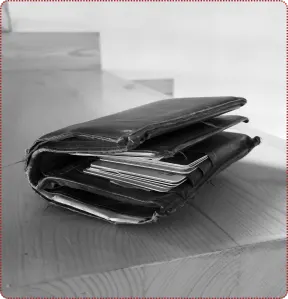
Why it happens
A leather wallet is soft by design. That's what makes it pleasant to hold — and it's also why it grows. Every extra card and folded receipt stretches the pockets a little more, and the wallet never quite springs back. Because the material is flexible, it can't hold cards in a fixed stack, so a bifold is always thicker than the cards it carries.
Carbon fiber works the opposite way. It's a rigid, very strong and lightweight material, so a carbon fiber wallet keeps the same slim shape whether it's holding three cards or ten. That rigidity is also what allows clever mechanisms, such as a lever that pushes your cards out in a neat stagger.
Already switched? Here's how to clean and care for a carbon fiber wallet so it stays like new.
Carbon fiber vs leather: side-by-side comparison
| Factor | Carbon fiber wallet | Leather wallet |
|---|---|---|
| Thickness | Slim, keeps its shape | Grows thicker as you add cards |
| Weight | Very light | Light to moderate, heavier when full |
| Durability | Resists scuffs, moisture and stretching | Develops patina, but wears at folds and edges |
| Card access | Fast, often with a pop-up mechanism | Slots stretch unevenly over time |
| RFID blocking | Commonly built in | Only on models with an added lining |
| Cash and coins | Bills via strap or back section; few coins | Bill compartment, often a coin pocket |
| Front-pocket carry | Easy | Usually too bulky |
| Style | Modern, technical look | Classic and traditional |
The takeaway is simple: if you carry a lot of coins and paper and love the classic look, leather still has a place. If you mostly carry cards and some cash and want a wallet that stays slim and organized, carbon fiber is the more practical material.
What people usually try first
Before switching materials, most people try to fix the wallet they have. Here's how the common fixes play out:
- Cleaning out the wallet: it helps for a few weeks, but a stretched leather wallet stays wide, and the receipts creep back in.
- A thin leather card sleeve: slimmer, but cards are still slow to get out, and there's rarely room for cash or protection.
- A basic aluminum card holder: slim and RFID-blocking, but many have no proper place for bills and no way to track the wallet.
- An AirTag dropped into the old wallet: it adds tracking, but creates a lump, and the tag can slide around or fall out. We compared the options in 5 ways to put an AirTag in your wallet.
Each fix solves one problem and leaves the others. That's why a purpose-built carbon fiber wallet like the SafeTrack Wallet makes sense: it handles slimness, card access, RFID protection and tracking in one design instead of four separate purchases.
Is carbon fiber really better for security?
Carbon fiber is conductive, which is why it's often used as part of an RFID-blocking shell that keeps contactless cards from being read while the wallet is closed. In everyday life, though, the bigger risk is usually simpler: the wallet gets left on a café table, slips out of a pocket in a taxi or disappears to a pickpocket. A slim wallet you can carry in your front pocket already lowers that risk (see front pocket vs back pocket wallet), and a tracker with left-behind alerts covers the rest. If you want the full picture on skimming, read our guide do RFID-blocking wallets actually work?
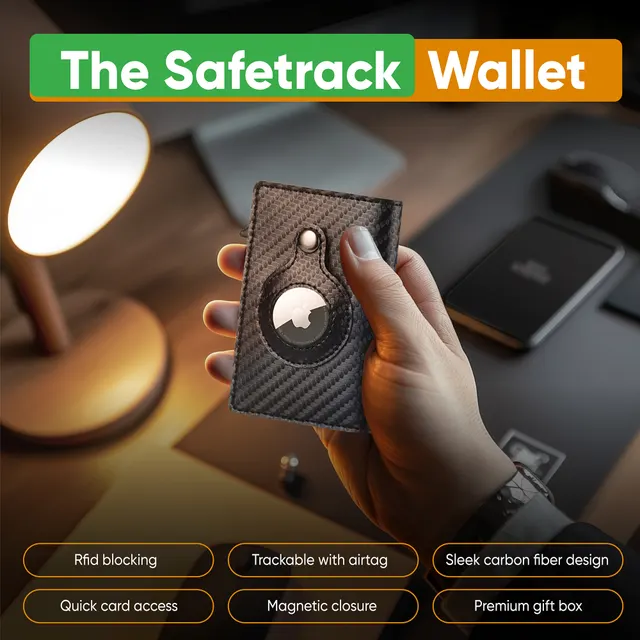
Our recommendation: the SafeTrack Wallet
If you're ready to leave the bulky bifold behind, the SafeTrack Wallet is the carbon fiber wallet we recommend. It was made for exactly this upgrade: everything people like about a minimalist carbon fiber wallet, plus the one feature most of them are missing — a way to find it.
- Rugged carbon fiber shell: lightweight, premium-looking and built to handle daily wear without stretching or fraying.
- Slim enough for the front pocket: about 1.7 oz and 3.86 x 2.56 x 0.83 inches, smaller than most phones.
- One-push card access: the slide lever fans your most-used cards out in a neat stagger, faster than wrestling a card out of a tight leather slot.
- RFID blocking, always on: shields the contactless cards and IDs inside with nothing to switch on.
- Built-in AirTag slot: add an Apple AirTag (sold separately) and the wallet shows up in Find My on your iPhone, with a map location, a sound you can play and left-behind alerts.
- Real capacity: the maker rates it for 1 to 14 cards or IDs plus up to 20 bills in the expandable back section.
Pricing is straightforward and gets better in bundles: 1 wallet is $44.95 (plus $4.95 shipping), 2 wallets are $79.90, and the most popular 3-wallet bundle is $105 ($35 each) with free shipping. The 5-wallet bundle brings it down to $33 each, also with free shipping — a smart way to upgrade the whole family or keep a gift ready. Every order is covered by a 90-day money-back guarantee, so you can carry it every day, take it on a trip and see how the carbon fiber holds up before you decide.
One honest note: tracking uses an AirTag and Apple's Find My, so that part is built for iPhone users. The carbon fiber build, RFID protection and fast card access work for everyone. For the full breakdown, read our complete SafeTrack Wallet review.
Frequently asked questions
Is a carbon fiber wallet better than a leather wallet?
For most people who want a slim, durable everyday wallet, yes. Carbon fiber wallets are thinner, lighter and more resistant to scuffs and moisture than leather, and many include RFID blocking. Leather still wins on classic looks and room for coins and receipts, so the right choice depends on how much you carry.
Do carbon fiber wallets scratch or break?
Carbon fiber is a rigid, very strong material that holds up well to daily wear. Like any hard surface it can pick up light marks over time, but it does not crack, stretch or wear thin at the folds the way an old leather wallet does.
Can a carbon fiber wallet fit in the front pocket?
Yes, that is one of the main reasons people switch. A slim carbon fiber wallet is far thinner than a stuffed bifold, so it slides into a front pocket, a jacket pocket or a small bag, which is also more comfortable to sit on and harder for pickpockets to reach.
How many cards does a carbon fiber wallet hold?
It depends on the model. Many minimalist wallets hold around 6 to 12 cards. The SafeTrack Wallet, for example, is rated by its maker for 1 to 14 cards or IDs plus up to 20 bills in its expandable back section.
Are carbon fiber wallets worth the money?
If you value a slim profile, fast card access and long-term durability, they usually are. A good carbon fiber wallet keeps its shape for years, and models that add RFID blocking and an AirTag slot replace several separate purchases with one.
Do I need an AirTag for the SafeTrack Wallet?
No, but it is the feature that makes the wallet findable. The AirTag is sold separately and works with Apple's Find My on iPhone. Without it, you still get the slim carbon fiber shell, RFID blocking and the slide-out card mechanism.
Heading out on a trip? Read our 9 ways to keep your wallet, passport and luggage safe while traveling — or go back to the homepage to see how SafeTrack works. Not sure your current wallet is done? Check the 9 signs you need a new wallet.